
Among food articles, vegetable prices surged by 69.69 per cent mainly on account of onion, which witnessed 455.83 per cent jump in prices, followed by potato at 44.97 per cent.

The government clarified that the majority of industrial establishments had reported nil production, and cautioned that the numbers should not be compared with those of previous months. "It is not appropriate to compare the IIP of April 2020 with that of earlier months, and users may like to observe the changes in the IIP in the following months," said the ministry of statistics & programme implementation.

Axis Bank and ICICI Bank consumed 37-59 per cent of their operating profit for COVID-19 provisioning, while the figure is 24 per cent in case of Kotak Mahindra Bank and 10-12 per cent for IndusInd Bank and HDFC Bank.

Spiralling prices pinched the pocket of consumer as edible oil, fuel and many other commodities turned dearer this year amid pandemic-induced disruptions but the inflationary pressure is anticipated to ease, though marginally, in the coming months. As consumers, at retail as well as wholesale levels, are willy-nilly learning to live with the new normal of curbs to contain the spread of coronavirus infections, experts are of the view that elevated inflation is likely to stay longer. After dealing with the devastating blows from the second COVID wave, especially during the April-June period, the economy is well on the revival path but the emergence of Omicron might unsettle the recovery trajectory in the short term.

Signs of financial stress were visible when the airline reported a loss of Rs 10.40 billion.

As per commerce and industry ministry data, food inflation fell to 4.91 per cent in March from 7.79 per cent in the previous month.

Is the worst over for Indian banks? The past two years saw them ride on treasury trades as deposits soared and credit growth dipped sharply. Gross and net non-performing assets (NPAs) moved south, and the provision coverage ratio (PCR), capital buffers, and profitability indicators are back at pre-pandemic levels. So, what's the plot ahead?

Build up inflation rate in the financial year so far was 2 per cent compared to a build up rate of 4.56 per cent in the corresponding period of the previous year. Inflation in food articles as a group rose to 11.08 per cent during the month as against 9.80 per cent in the previous month, mainly driven by exorbitantly high onion prices, the rates of which spiked by over 172 per cent from a year-ago. The annual rate of inflation, based on monthly wholesale price index was at 0.16 per cent in October.

After unseasonal rains, supply disruptions and pandemic-induced woes pushed retail inflation well over the Reserve Bank's comfort zone in 2020, the scenario is likely to stay that way at least in the short term as economic recovery slowly gains foothold. For most part of this year, pricier food items pushed the retail inflation, based on Consumer Price Index (CPI), higher in the range of 6.58-7.61 per cent, except for March when the reading was 5.91 per cent. Experts believe retail inflation is likely to average around 6.3 per cent this fiscal and mostly will remain sticky going forward owing to pick-up in demand across sectors.

Rating agency ICRA on Wednesday revised down its credit growth outlook for banks to 2-3 per cent for the current fiscal, and said the coronavirus pandemic-driven stress may leave 3.1-3.7 per cent of assets into bad loan list by March.

As many as seven of eight core industries saw a contraction in output in September.

RBI had on February 12, 2018 issued a circular saying that lenders have to provide for resolution plan within 180 days in case of large account of Rs 2,000 crore and above.

Depreciating the rupee against the dollar to boost economic growth has fiscal constraints and monetary limitations

For non-banks, the IL&FS crisis was nothing short of India's Lehman moment, which has for a foreseeable future reset the sector on multiple grounds.
Will demonetisation lead to a rate cut, leading to higher quantum of lending?

Retail inflation remained above the RBI's comfort level for the second consecutive month despite slipping slightly to 6.26 per cent in June while the factory output recorded a growth of 29.3 per cent in May, mainly on account of the base effect, the government data showed. The marginal slippage in the Consumer Price Index (CPI)-based inflation was noticed despite little firmness witnessed in the food inflation which inched up to 5.15 per cent in June from 5.01 per cent a month ago. Retail inflation based on Consumer Price Index (CPI) was 6.3 per cent in May 2021 and 6.23 per cent in June 2020.

If this turns into reality, India's gross domestic product (GDP) growth will be the lowest since 2012-13, which could severely hit job creation and income growth in the near term.

New norms are in place to strengthen regulations for this set of lenders which has been playing a critical role in Asia's third largest economy, notes Tamal Bandyopadhyay.

The airline has struggled to pay salaries and vendors on time and its Rs 10,963 crore fund and non fund based facilities have now been assigned 'D' rating by ICRA - the seventh rating downgrade since March 2017.

The nationwide implementation will increase churn of customers, shoot-up the customer acquisition and retention costs, and lower the average revenue per user as competitive tariff plans will have to be offered, the agency said in a note.

This is the third consecutive month when GST mop-up remained below the Rs 1 lakh crore mark, despite the festival season.

India's dependence on imported crude oil to meet domestic demand has been a matter of concern for years. Delivering the inaugural address at the global energy summit - Urja Sangam - in 2015, Prime Minister Narendra Modi had called for enhancing domestic oil and gas production to cut the import burden. He aimed at lowering it by at least 10 per cent by 2022 - to coincide with the platinum jubilee of India's independence. But this target is far from being achieved and the country's import reliance has only risen.

RBI targets to keep inflation at 4 per cent, (+/- 2 per cent), and its rise beyond this comfort zone will put pressure on the central bank to hike rates.

Economic affairs secretary S C Garg said that all macroeconomic parameters are performing well.

Industrial production (IIP) grew to a three-year high of 6.4 per cent in August, up from 4.1 per cent in July.

After contracting for two quarters in a row, the Indian economy entered the positive territory with a growth of 0.4 per cent in the October-December quarter, mainly due to good performance by farm, services and construction sectors, official data showed on Friday. Trade and hotel industry registered a contraction of 7.7 per cent during the third quarter this fiscal, as the sectors continued to suffer on account of coronavirus pandemic. According to the data released by the National Statistical Office (NSO), the farm sector recorded a growth of 3.9 per cent, and the manufacturing sector output grew by 1.6 per cent in the quarter under review.

More than half of the total subsidy provisioning, amounting to 54 per cent, is going towards food subsidy, which is estimated at Rs 184,220 crore for 2019-20 - a 7.5 per cent increase over the revised estimates for 2018-19.

'It has taken us 15 years to get to where we are. It obviously doesn't happen overnight.'


The retail inflation, which is factored in by the RBI to arrive at its monetary policy, has been on decline since last month. The previous low was 5.54 per cent in November 2019. The government has asked the RBI to restrict the inflation around 4 per cent, with a margin of 2 per cent on the either side.

Brent crude oil price surged 4 per cent on Friday, following tension between Iran and the US. Airlines, however, have been unable to pass on the price increase to customers due to the soft demand.

Most NBFCs will have to slow down their loan growth. Some of the most leveraged will have to sell a part of their assets (or loan book) to banks to raise incremental capital. Others may have to knock on the door of their deep-pocketed parents.
The loans securitised between January 2004 and December 2006 have shown progressively lower collection efficiency and hence, higher delinquency levels. In fact, among all the years, the pools securitised in 2006 have shown the weakest performance, rating agency ICRA said.

A number of public sector banks will have to stock up on core capital, if the Reserve Bank of India decides to ask banks to leave out hybrid instruments while computing Tier-I capital adequacy, as indicated by RBI last week.
There is little doubt that the global economic crisis has worsened Indias growth prospects, but the slowdown began long before the US financial meltdown began.

GST collections in March touched a record high of over Rs 1.23 lakh crore, a 27 per cent growth over the year-ago period, the Finance Ministry said on Thursday. "GST revenues crossed above Rs 1 lakh crore mark at a stretch for the last six months and a steep increasing trend over this period are clear indicators of rapid economic recovery post pandemic," the ministry said. Closer monitoring against fake-billing, deep data analytics using data from multiple sources including GST, income tax and customs IT systems and effective tax administration have also contributed to the steady increase in tax revenue over last few months, it added.
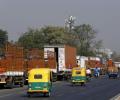
The industry said if the policy was announced, it would have taken 28 million vehicles bought before March 2005 off the road.

India's Rs 4.5-trillion fast-moving consumer goods (FMCG) sector was one of the first to bounce back from the lockdown induced blues, reporting a year-on-year (YoY) growth in the October-December quarter last year. That said, the overall consumption figures continue to remain depressed. The FMCG market, which includes daily consumables like branded atta, hand sanitizers, edible oils, shampoos, razors, and so on, recorded 7.3 per cent value growth during the period, while the smartphone market grew by 21 per cent.
A day after Manmohan Singh won the trust vote, sans Left support, rating agencies Moody's Investor Services and Icra said the insurance sector will get a huge boost if the government paves the way for greater foreign participation in Indian companies.
Family-owned companies like those of Tatas, Birlas and Ambanis are dominating the country's corporate landscape, but still face challenges regarding corporate governance norms such as appointment of successors and transparency in functioning, rating agency Moody's said. However, these companies have responded well to opportunities available in the fast-growing and liberalizing economy, according to a joint survey by Moody's Investors Service and its domestic associate.
